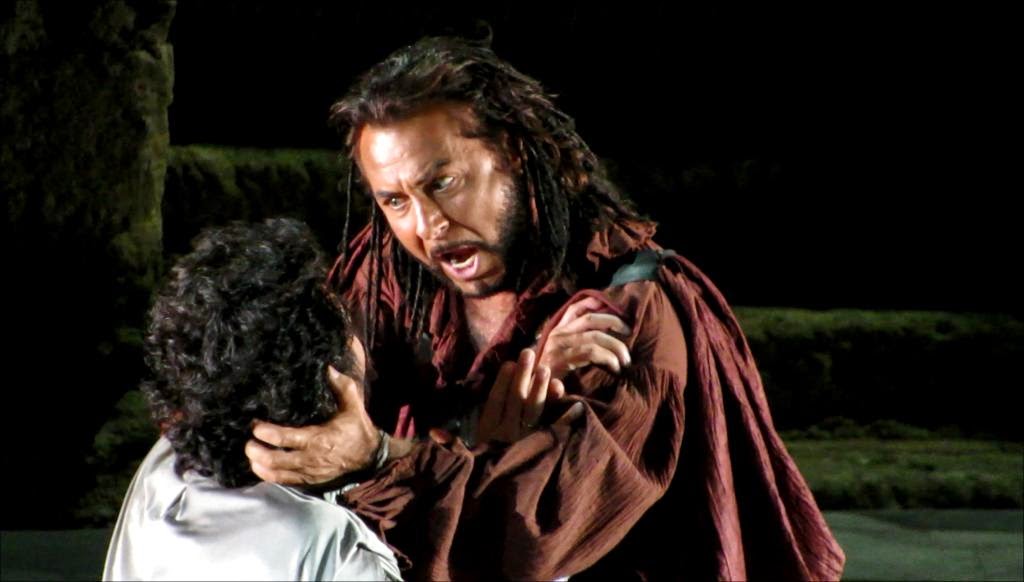
Carmen at Chorégie d’Orange was TV live broadcast less than two weeks ago. Contrary to the Puccini operas or the dreaded Verismo repertoire, Carmen is always enjoyable to listen to, so even when the visuals are less appealing you may always take pleasure in music and good singing — especially with the cast like the one chosen for this year’s Carmen in Orange.
Wednesday, July 22, 2015
Monday, July 20, 2015
Operalia 2015 - We love Lise!
Despite atrocious conducting [can someone please tell Placido Domingo that he cannot conduct?!], Operalia remains a superb annual concert of amazing young operatic talents that are most likely to become operatic stars tomorrow. This year finalists
were truly excellent. Congratulations to each and every one of them for brilliant performance, and to Placido Domingo for organizing this event!
Lise Davidsen, however, still managed to steal the show with a sensationally high-octane singing of "Dich teure Halle!"
Ladies and Gents I believe we just got our next "Nina Stemme" — not to dig farther in the past and make comparison with other famous Scandinavian dramatic sopranos…
You can watch the whole concert on Medici.tv.
Winners: Ioan Hotea (a superb tenor!) and Lise Davidsen.
- Edward Parks, baritone, USA, 31
- Andrea Carroll, soprano, USA, 25
- Julien Behr, tenor, France, 32
- Kiandra Howarth, soprano, Australia, 25
- Bongani Justice Kubheka, bass-baritone, South Africa, 24
- Hyesang Park, soprano, South Korea, 26
- Tobias Greenhalgh, baritone, USA, 26
- Darren Pene Pati, tenor, New Zealand, 27
- Noluvuyiso Mpofu, soprano, South Africa, 24
- Ioan Hotea, tenor, Romania, 25
- Lise Davidsen, soprano, Norway, 28
were truly excellent. Congratulations to each and every one of them for brilliant performance, and to Placido Domingo for organizing this event!
Lise Davidsen, however, still managed to steal the show with a sensationally high-octane singing of "Dich teure Halle!"
Ladies and Gents I believe we just got our next "Nina Stemme" — not to dig farther in the past and make comparison with other famous Scandinavian dramatic sopranos…
You can watch the whole concert on Medici.tv.
Winners: Ioan Hotea (a superb tenor!) and Lise Davidsen.
Sunday, July 19, 2015
Abduction in Glyndebourne
Die Entführung aus dem Serail is being live streamed from Glyndebourne and the Mozart aficionados will know to appreciate.
If you missed the live-stream you will still be able to catch on via The Guardian and obviously The Glyndebourne Festival websites.
The show, staged by the very conservative David McVicar, will please his targeted audience. It is conducted by the uber-talented Robin Ticciati and with Edgaras Montvidas in the role of Belmonte you will definitely spend good couple of hours.
Saturday, July 18, 2015
Never hate your enemies. It affects your judgment.
Belcanto operas are known to be super-difficult to stage because of the poor librettos. Most of the belcanto productions are truly dreadful and the common attitude is that the concert versions of operas operas are far better and more efficient than the staged attempts to make the lame-ass librettos look plausible on stage.
Christof Loy’s take at I Capuletti e I Montecchi at Zurich Opera — the house run by the unsurpassable Andreas Homoki — is an example of precisely the opposite. He turned this butchered text of Romeo and Juliet into a SUPERB theater piece — premiered las month at the 2015 Zurich Opera Festival. His outstanding staging is based on mafia rivalry and highly inspired by The Godfather and the direction that respected the timings of this opera to a precision that only can fills you with awe and respect for the director. It takes a village… so this show wouldn’t be as fantastic if it was without the sensational cast lead by Olga Kulchynska (what a superb singer!), always reliable and brilliant Joyce DiDonato, as well as Benjamin Bernheim (!) in one of his finest interpretations.
To me this is clearly the best Christof Loy production of a belcanto opera since his La Donna del Lago in Geneva — which was unfortunately never broadcast or recorded on DVD (I should emphasize that I loathed his Lucrezia Borgia despite the rave reviews it received at the time it was premiered in Munich).
As much as I thought Fabio Luisi was awkward in Wagner, I thought he was the master of the Universe while conducting this opera…
Major props are due to Christian Schmidt for sets and costumes.
This compelling show --which is a rarity today!-- can be seen on Arte on this link
Sunday, February 8, 2015
Renaissance of the Paris Opera?
After the years of appalling mediocrity and catastrophic productions presented at the Paris
Opera, the new artistic direction --lead by the formidable Stéphane Lissner-- is proposing
a fantastic program for their first season (2015-2016) which is likely to revive our passion
for opera in Paris that was sadly reduced to a few OKish productions presented at the Théâtre des Champs Elysées during the past several years.
What new productions?
Monday, November 3, 2014
Interesting news from Munich
Two weeks before la prima of the new production of Manon Lescaut at the Bayerische Staatsoper in Munich, the house announced today that Anna Netrebko decided to pull out from the show. It is quite clear from the press release that the main reason for her withdrawal is that she does not like the Hans Neuenfels production. Details are obviously unclear:
Did she she withdraw earlier and they did not want to pass information to public until they made sure with Kristine Opolais would step in, or she abruptly decided not to sing because the whole production was not quickly redesigned and reorganized to meet her requirements?
I hope the latter is not true and Anna is not suffering from inflated diva-ego-itis... yet.
The fact that she showed off her Halloween outfit a few days ago (?) suggests that she's still that same down to earth person we love...
During the premiere performances of Giacomo Puccini’s Manon Lescaut (15th, 19th, 24th, 27th, 30th November as well as 4th and 7th December) Kristīne Opolais will replace Anna Netrebko in the title role.
General Manager Nikolaus Bachler expressed his deep regret that Anna Netrebko would not be performing. “We would still like to thank Anna Netrebko for deciding at an early stage that, due to differing artistic perspectives on the work, she would prefer to pull out. The Bayerische Staatsoper is well known for combining first-class musical quality with exciting and innovative directorial approaches. In this field this can, of course, mean that in rare cases certain artistic constellations don’t work out. But, we’re looking forward to welcoming Kristīne Opolais back and working together again with Anna Netrebko in future seasons.”
Did she she withdraw earlier and they did not want to pass information to public until they made sure with Kristine Opolais would step in, or she abruptly decided not to sing because the whole production was not quickly redesigned and reorganized to meet her requirements?
I hope the latter is not true and Anna is not suffering from inflated diva-ego-itis... yet.
The fact that she showed off her Halloween outfit a few days ago (?) suggests that she's still that same down to earth person we love...
Saturday, November 1, 2014
Friday, October 31, 2014
DVD -- Tcherniakov & Warlikovski
Two DVD to cherish, recorded at the World's best opera house --La Monnaie/De Munt:
As for the other two outstanding directors, I saw the new production of Die Soldaten at the Komische in Berlin [I will write a separate note on that] in which Calixto Bieito once again reminded us who is a true master of the razor-sharp story-telling and who has audacity to do what no one else can.
Romeo Castellucci is presenting his theater pieces in Paris this fall [hopefully this time without religious freaks interrupting the shows!]: Go Down Moses this week at Théâtre de la Ville, Schwanengesang D744 at Buffés du Nord, and Le Sacre du Printemps at Grande halle de la Vilette [due to unprecedented demand the organizers added an extra date, so you may still find free tickets for Le Sacre].
Note also that tomorrow, November 1st 2014, at 6 PM (cet) the Bayerische Staatsoper will live stream their new production of The Makropulos Affair -- one of the best operas there is ;)
- Dimitri Tcherniakov production of Il Trovatore: After his superb humanistic approach to one of the most reactionary operas, Dialogue des carmélites, he deconstructed Il Trovatore by essentially eliminating its subliminal and profoundly racist tone.
- Krzysztof Warlikowski did a stunning job with Lulu: while DVD remains just a good approximation of the live experience, this production definitely deserves its place in any DVD collection of outstanding opera productions and makes us regret that his unforgettable production of Macbeth (also at La Monnaie) has not been released on DVD.
As for the other two outstanding directors, I saw the new production of Die Soldaten at the Komische in Berlin [I will write a separate note on that] in which Calixto Bieito once again reminded us who is a true master of the razor-sharp story-telling and who has audacity to do what no one else can.
Romeo Castellucci is presenting his theater pieces in Paris this fall [hopefully this time without religious freaks interrupting the shows!]: Go Down Moses this week at Théâtre de la Ville, Schwanengesang D744 at Buffés du Nord, and Le Sacre du Printemps at Grande halle de la Vilette [due to unprecedented demand the organizers added an extra date, so you may still find free tickets for Le Sacre].
Note also that tomorrow, November 1st 2014, at 6 PM (cet) the Bayerische Staatsoper will live stream their new production of The Makropulos Affair -- one of the best operas there is ;)
Pur ti Miro
Clash of the two our most beloved divas, Sonya Yoncheva and Max Emanuel Cencic
from the superb Jean-François Sivadier production of l'Incoronazione di Poppea presented in Lille, 2012.
Tuesday, October 28, 2014
L’Enlèvement au Sérail - Opéra Garnier à Paris
Musically it was a lovely evening and a radio recording might make many Mozart aficionados happy for a few hours [Philippe Jordan deserved ovations, as well as Bernard Richter, Erin Morley and Anna Prohaska]. The show itself, however, is a total flop. There is literally nothing salvageable in this moronery...
Last Spring the pleasure of experiencing a very good Robert Carsen production of Die Zauberflöte was partly ruined by the fact that it was given at the immense auditorium of Opéra Bastille. That flaw was corrected for this time and the Entführung aus dem Serail is presented at Garnier. Hélas, the show is most of the time an insult to our intelligence. We are not that shallow or naive. We do not go to opera to be seen and hope to be perceived as cultivated. We are not at the opera for the first time...
I wonder if there is anyone serious elaborating a strategy on how to preserve opera in the 21st century. This is definitely not a way to go. Why would anyone pay 140€/seat and go to theater to see a parade of stupidity that we could see [zap through] a week later on-line anyway?
A good production of this opera is possible and it is given almost every year at the Komische in Berlin.
DVD offer of this opera is actually quite good -- the Johan Simons production and the one by Stefan Herheim stand out though. I didn't find them on YouTube but I just realized that a delicately constructed Christof Loy production is available, as well as one creative Stuttgart show.
Monday, August 11, 2014
Otello Alagnesque
Like every year, two new opera productions were presented at Les Chorégies d'Orange 2014, Nabucco and Otello [2 shows each], and one of the shows was broadcast on national TV broadcast - Otello on France2, August 5 2014.
Sunday, June 22, 2014
Devastating Orphée in Brussels "Rien n'égale mon malheur..."
This is undoubtedly the best show I've seen since Parsifal staged by the very same Romeo Castellucci. Only 20min into the show I felt I was on the edge of tears and was holding back until the last 15min and then wept like a willow... almost felt embarrassed when the light came back on.
Warlikowski can sometime go deep and tackle your hidden emotion... but this is a whole another level yet. The concept is very simple, the message extremely poignant, and the impact on me/us was simply devastating... especially the moment of complete darkness when Orphée sings the celebrated aria was heartbreaking [Stéphanie D'Oustrac IS the most wonderful singer today! She's not the loudest, her voice is not the most beautiful, but no other singer can sing like her... It simply happens with her like with no other singer out there...]
You MUST be there to feel the show. This cannot work via webcast or a video recording. It simply drags you in and grabs your every emotion... Will write more when I come back to Paris.
Romeo Castellucci is a theatrical genius!
THANK YOU to Romeo and his team, and to Peter De Caluwe and this incomparable opera-theater!
J'ai perdu mon Eurydice...
The best run opera house in the world --with the most exciting and steadily good programs-- that at the same time shows the role opera should play in the 21st century --La Monnaie/De Munt-- is presenting these days their new production of Orphée et Eurydice directed by no one else but Romeo Grandioso Castellucci and with our huge fave Stéphanie D'Oustrac singing the role of Orphée [isn't she the most wonderful singer today?!]
Yours Truly obviously could not resist temptation and hopped on Thalys to spend a Sunday in Brussels and see this singular operatic event this year.
In Paris, the new production of La Traviata -- I won't blog about that. It is fair to say that it is only better than the dreadful Richard Eyre production that was contaminating London/ROH for years and --worse-- numerous DVD players worldwide...
Instead of reviving the extraordinary Christoph Marthaler production (that you can see on YouTube), or producing something astounding, along the lines of what Benedikt von Peter did in Hannover, Peter Konwitschny in Graz & London/ENO, or even Hans Neuenfels in Berlin/Komische... the artistic leadership of the Paris Opera confided a job to a tired French film director who only demonstrated his artistic emptiness and an astonishing lack of opera producing skills... In the end, and despite our dear Diana Damrau singing phenomenally the role of Violetta Valéry, the result was truly pitiful...
OK, let's get ready for Orphée: an interview with Romeo Castellucci about this opera and his production
Excellent Trailer:
Sunday, June 8, 2014
Der Glyndebournenkavalier
Interestingly, Robin Ticciati will be conducting. He's only 31 and starting from this year he is also the Glyndebourne festival music director. Among the cast member keep an ear on a superbissimo Andrey Dunaev (tenor)...
Saturday, May 31, 2014
Twelwe-tone celebration: Zimmermann's Die Soldaten -- webcast from Munich
Andreas Kriegenburg is in charge of staging of this amazing opera and the choice to choose him for directing this opera is excellent, which makes me very optimistic for the tonight's show -- live from the Bavarian State Opera in Munich, webcast following this link starting from 19:00 CET.
![]() |
| Visual resemblance with the characters of the Kriegenburg production of Wozzeck is obvious... |
Sunday, April 6, 2014
Max Emanuel Cencic
The CD market pretty much dried up but happily iTunes and Amazon still propose a way to get new albums and enjoy music we all love.
At some point there were just too many CD releases and without proper guidance one would easily get drowned by too many slightly different sounding arias recorded (and sound engineered) time and time again. Jonas Kaufmann had that first CD that clearly stood out from the rest. It invited us for something different -- something truly artistic. After that album, Jonas surprised us even more by delivering one of the best lieder-album ever, the one that made us appreciate his unique artistic style and made us rush to each of his Liederabende in Paris (or elsewhere) that soon became the most appreciated concerts in Paris every year. The first was audaciously organized at Opéra Garnier by Gérard Mortier...
Then came the pressure on Kaufmann to sing Wagner and to record more and more and more... and so the Jonas' recordings started to lose that special subtle thread of genuine beauty -- some of the albums that followed were OK-ish, some yawnish and some downright bad. His new album --his take on Winterreise-- is definitely his return to the greatness. While it does not reach the heights of Winterreise sung by Christine Schäfer or by Dietrich Fischer-Dieskau, it is every bit as good as that sung by Gerhaher, Quasthoff , Bostridge... and arguably even better.
To me the best recording in years was Ombra Cara by Bejun Mehta after which I definitely became a BM fan. In the same league is the newly released recording of Max Emanuel Cencic which to me is among the most exciting releases of the past 10 years or so. It is called Rokoko and it includes 14 opera arias by Johann Adolf Hasse that not many of us are familiar with. Cencic, the man with admittedly a poor fashion sense (jk) but with an absolutely divine voice did his magic again and made us fall in love with this repertoire.
Another thing: If you ever get a chance to listen to Max singing live, do not miss it for anything (his solo concerts in particular)! That man simply has a divine talent -- magic voice and the uncommon interpretative skills.
Monday, March 17, 2014
Krzysztof Warlikowski se souvient de Gérard Mortier
Parfois, le plus important dans ce qui se noue entre deux
êtres est contenu dans la façon dont ils se rencontrent. Avec Gerard
Mortier, j’ai eu le sentiment d’une approche d’une rare élégance, digne
du XIXe siècle, dans la manière dont il m’a signalé qu’il voulait me
faire travailler. Rentrant de vacances en Italie, je me vois faire une
chose que je ne fais jamais : je regarde dans ma boîte aux lettres et
j’y trouve une enveloppe de l’Opéra de Paris ! C’est une lettre de son
nouveau directeur Gerard Mortier, dont je n’avais jamais entendu
parler. Je préparais alors Wozzeck d’Alban Berg pour l’opéra de Varsovie. Depuis, je n’arrête pas de me dire : et si je n’avais pas trouvé cette lettre… ?
C’est quand même la classe, quelqu’un qui vous écrit une lettre sans même vous connaître… Tout aussi classe fut notre rencontre à Paris. Nous avons tout de suite su qu’on n’était pas là pour se parler d’opéra, alors on a évoqué Proust durant trois heures d’affilée. Au départ, Gerard Mortier vient vers moi parce qu’il cherche un metteur en scène polonais pour la future création du Roi Roger de Karol Szymanowski, prévue pour la fin de son mandat. Mais une semaine après cette rencontre, il m’appelle et me dit : “Krzysztof, j’ai encore un projet pour vous.” Et cinq mois plus tard : “J’ai un autre projet pour vous.” C’est comme ça que ça a commencé et de fil en aiguille, il m’a inscrit à l’affiche des quatre saisons à venir de l’Opéra de Paris avec Iphigénie, de Gluck (2006), L’Affaire Makropoulos, de Leos Janacek (2007), Parsifal de Wagner (2008), et Le Roi Roger de Karol Szymanowski (2009). L’extraordinaire, c’est que cette rencontre autour de Proust nous avait révélé à quel point on se comprenait et qu’il fallait tout de suite se mettre à l’œuvre.
L’autre extraordinaire, c’est que, lorsqu’ il m’a rencontré, Gerard Mortier ne connaissait rien de mon travail et j’ai appris bien plus tard que c’était Patrice Chéreau qui lui avait parlé de moi à propos de ma mise en scène au théâtre de Kroum d’Hanokh Levin. C’était si généreux de la part de Patrice, qui était d’ailleurs le metteur en scène le plus généreux que j’aie connu.
Avec Gerard Mortier, on a commencé avec Gluck (Iphigénie) et on a fini avec Gluck (Alceste). D’emblée, j’ai senti qu’il me soutiendrait. Car, c’est impossible de travailler et de faire un bout de chemin avec un directeur qui vous a déniché par hasard sans savoir qui vous êtes, si l’on n’a pas la certitude qu’au moment le plus crucial de la création, il sera le premier à prendre votre défense. Et Gerard Mortier a été comme ça dès les premières répétitions d’Iphigénie et jusqu’au bout de notre parcours commun.
Evidemment, ce type d’attitude vous donne envie de faire toujours mieux, de travailler encore, d’aller plus loin avec l’autre. Il était convaincu de l’importance de l’opéra, qu’il ne fallait surtout pas considérer comme un art mort, mais au contraire, qu’il fallait intégrer aux mouvements artistiques de la société dans laquelle nous vivons. Moi, je venais du théâtre et je ne pouvais pas penser autrement l’opéra. C’est sûrement pour ça qu’on s’est tout de suite entendus.
Après Gluck et Janacek, Gerard Mortier a pris un très grand risque, celui de me confier la mise en scène de Parsifal de Wagner, la Bible de tous les fans d’opéra, à moi, un Polonais ! Car c’était lui qui était à l’origine de chaque proposition d’opéra dont il souhaitait me confier la mise en scène. Là est le savoir d’un directeur. Tout son art consiste à faire se rencontrer un chef d’orchestre et un metteur en scène en sachant sur quelle œuvre il pourra les faire dialoguer et ensuite, quels chanteurs et chanteuses peuvent s’accorder avec ce chef et ce metteur en scène. Plus qu’un savoir, c’est principalement ce génie intuitif qui caractérisait la méthode Mortier.
Du reste, je pense que son dernier casting pour Alceste fut celui d’un “crépuscule des dieux”, avec en perspective une évocation de la fin pour chacun de nous. Il se trouve que j’ai 52 ans, l’âge des questionnements sur ma carrière d’artiste. C’est aussi très exactement l’âge de la chanteuse Angela Denoke qui interprète Alceste. Et surtout, cela devint évident lorsqu’on apprit durant les répétitions la maladie de Gerard, avec la terrible certitude de sa fin prochaine. La descente aux enfers d’Alceste a pris tout à coup un tour métaphorique, comme un décalque du réel. On savait dès le début que l’Inferno de l’acte III se devait d’être quelque chose qu’on lui dédierait, qui parlerait de la situation qu’on était en train de vivre, transcendée par l’ultime désir de le voir continuer d’exister.
C’est cette partie qui a posé le plus de problèmes au public de Madrid qui a préféré baisser la tête plutôt que de la regarder et a été la cause principale des huées à la fin de la représentation. Je n’avais pas entendu l’expression d’une telle désapprobation depuis longtemps, depuis Iphigénie à Paris, peut-être… Pourtant, j’avais l’impression d’avoir proposé une mise en scène apaisée, il y a une telle sagesse dans ce personnage d’Alceste qui va en enfer et fait le sacrifice de sa vie par amour.
La dernière image, c’était le corps d’Alceste sans vie, allongé sur le sol. Suite à la mort de Gerard qui n’avait pas pu assister à la première, conserver cette fin m’est devenu impossible. Je ne pouvais pas me contenter de dédier à sa mémoire cette vision d’un corps sans vie abandonné au milieu du plateau. J’étais déjà rentré à Varsovie et c’est au téléphone que j’ai contacté Angela Denoke et les équipes restées sur place pour les convaincre de modifier l’image finale. Pour qu’Angela ne tombe plus, mais sorte du plateau, attirée par la lumière comme le signe de l’espérance d’un ailleurs que je souhaite pour Gerard après sa mort.
Krzysztof Warlikowski in Les Inrocks
Wednesday, March 12, 2014
Gérard Mortier n'est plus
I did not know Gérard Mortier personally, but he was THE person who I truly admired in the world of Opera.
He was the one who made me love opera and who made me realize that opera is actually not dead art.
This is a devastating news for opera. He was a person of importance, capable to resist the tsunamis of conservatism, who articulated his dislike of the pitiful opera productions, unambitious projects that reduce opera to singing on a kitchy stage [cf. 90% of new productions at the Paris Opera, the Met, or at the ROH /where Holten is trying to change the things/]
He was a man who saw opera as a vector to further humanize our lives, to question our certainties, doubt our principles, and bring more nuances to our lives, more beauty and more tolerance... He was incessantly trying to democratize opera and pluck it from the claws of those rich who see in opera just an entertainment value...
Will Peter de Caluwe and a handful of other talented visionaries be able to fill his shoes, to resist and prevent opera from falling 100% back to the hands of aggressive ultra-conservatives?!
I certainly wish and hope they will...
I am very very very sad today :(
Thursday, October 31, 2013
Must see: Parsifal by Romeo Castellucci and Hartmut Haenchen
In the sea of theatrical mediocrity that we are offered to see at the opera houses these days, some gems still get to shine through.
Tcherniakov hits the cord every time he stages a new opera (he managed to sculpt the life-loving story out of Les Carmélites, render Il Trovatore not-racist, return Onegin the Russain romanticism,...); Warlikowski manages to tickle our subconsciousness by his thrillingly complex (emotionally and intellectually) productions; Bieito with his razor-sharp theatrical language finds and conveys a deeper and emotionally or socially engaging content of any given opera to his public. There are a few others that probably match these standards but not to this extent or not as consistently at that level as the above mentioned guys...
Romeo Castellucci is the other kind of gem. He is not an opera producer. He is a hard core avant-garde of today's theater and his take on Parsifal was very peculiar, philosophical, intellectually stimulating, deeply human(izing) and also spectacular [despite its somewhat unspectacular ending]. It was one of the very few opera productions that remains with your for a very-very long time after the show, haunting your brain and your heart. *
Now, good news is that you can order a copy of DVD of that sensational production of Parsifal that I was more than happy to be able to see at La Monnaie/De Munt in 2011, and then blogged about here. DVD is never a substitute for the real show but it is the best approximation we might have. I saw the DVD last night and I absolutely loved it although I have trouble focusing at my work today ;)
[Did I say that Anna Larson was by far the best Kundry of all time?!]
Trailer below.
*) This is to date the only opera production signed Romeo Castellucci. If you get to see his "Sul concetto di volto nel figlio di Dio", it is very engaging and deeply touching as well. Unfortunately, when it was given at Théâtre de la Ville in Paris, it was a trigger for the protests of ultra-conservatives who organized the demonstrations in front of the theater every night so that the police special forces had to ensure the minimal security conditions for the shows to happen. The protesters were mostly politically manipulated by those who did not want to understand a deeper meaning of the content of the story but preferred to see the imagery that they found outraging. And yet that was one of the best evenings at a theater I have ever experienced in my life...
Tcherniakov hits the cord every time he stages a new opera (he managed to sculpt the life-loving story out of Les Carmélites, render Il Trovatore not-racist, return Onegin the Russain romanticism,...); Warlikowski manages to tickle our subconsciousness by his thrillingly complex (emotionally and intellectually) productions; Bieito with his razor-sharp theatrical language finds and conveys a deeper and emotionally or socially engaging content of any given opera to his public. There are a few others that probably match these standards but not to this extent or not as consistently at that level as the above mentioned guys...
Romeo Castellucci is the other kind of gem. He is not an opera producer. He is a hard core avant-garde of today's theater and his take on Parsifal was very peculiar, philosophical, intellectually stimulating, deeply human(izing) and also spectacular [despite its somewhat unspectacular ending]. It was one of the very few opera productions that remains with your for a very-very long time after the show, haunting your brain and your heart. *
Now, good news is that you can order a copy of DVD of that sensational production of Parsifal that I was more than happy to be able to see at La Monnaie/De Munt in 2011, and then blogged about here. DVD is never a substitute for the real show but it is the best approximation we might have. I saw the DVD last night and I absolutely loved it although I have trouble focusing at my work today ;)
[Did I say that Anna Larson was by far the best Kundry of all time?!]
Trailer below.
Note that in June/July 2014 La Monnaie will give a new production of Orphée et Eurydice staged by Romeo Castellucci and with an amazing Stéphanie d'Oustrac in the role of Orphée. Do plan your trip to Brussels.
*) This is to date the only opera production signed Romeo Castellucci. If you get to see his "Sul concetto di volto nel figlio di Dio", it is very engaging and deeply touching as well. Unfortunately, when it was given at Théâtre de la Ville in Paris, it was a trigger for the protests of ultra-conservatives who organized the demonstrations in front of the theater every night so that the police special forces had to ensure the minimal security conditions for the shows to happen. The protesters were mostly politically manipulated by those who did not want to understand a deeper meaning of the content of the story but preferred to see the imagery that they found outraging. And yet that was one of the best evenings at a theater I have ever experienced in my life...
Wednesday, October 9, 2013
La mort d'un grand homme
To me Patrice Chéreau will be remembered as one of the great men of 20th century theater, a man who embraced opera and elevated it to the heights that assured its status of gesamtkunstwerk to our days. He will also be [and should be] remembered as a great man who had courage and intellectual audacity to take Wagner away from the hands of fascists & right wingnuts and show the world that The Ring can be interpreted in a radically new way, as to resonate with our time and with us.
He was one of the precursors of the modern day theatrical language in which theater offers a quality that no TV or cinema can offer; in which a pure human emotion transcends the limits of mostly poor operatic librettos thanks to his ability to distinguish those emotions and shape them on the stage in a very peculiar way (cf. his stagings of the two operas by Berg).
Naturally, the late Chéreau did not have that same vigor to defy the crowds of those who believe that "art must be beautiful" or that "the opera staging is about the colored tableaux", but still remained true to his art that we dearly loved and deeply respected.
RIP
Subscribe to:
Posts (Atom)